

Cheshire Lasers provides IPL hair removal at our clinic in Middlewich, Cheshire. The light is absorbed by the pigment in the hair and heats the root, so that regrowth becomes slower, finer and patchier with each treatment.
Most people come to us for the underarms, bikini area, legs, face or neck, and we treat a good number of men for backs and chests.
We use the Lumina AQS, made by Lynton Lasers, a few miles down the road in Holmes Chapel. There are gentler systems on the market, but we use IPL because our Lynton machine gives better results. Your treatments are carried out by our NVQ Level 4 laser technician.
Which areas can we treat?
We treat most areas of the face and body.
Face and neck: upper lip, chin, sideburns, jaw, earlobes, between the eyebrows and the neck, either as single areas or as a full face.
Body: underarms, upper or lower arms, bikini area, upper or lower legs, navel, chest, and the back and shoulders.
The bikini area can be treated as a bikini line, an extended bikini line or a Brazilian, on its own or combined with the underarms.
Areas can be combined in one appointment, and how long the treatment takes depends on how much is being covered.
How much is IPL hair removal?
Every course starts with a consultation and patch test, which is £30 and must be at least seven days before your first treatment.
Facial treatments are priced by the size of the area rather than by name — one small area, two small areas, a medium area, a large area, or a combination. These start at £49. Body areas start at £65 for the underarms.
Do you offer a discount for a course of treatments?
We offer a discount when you book a course of three treatments — see our current special offers. We do not sell larger packages. Most people do not need that many treatments in one block, and any that are not used are wasted.
Maintenance treatments after nine sessions
Once you have completed more than nine treatments on an area with us, you are welcome to come back for half-price maintenance treatments at any time, as long as you have had a treatment or a patch test with us within the last six months. A patch test on its own is £25.
View all our IPL and laser hair removal prices here.
Book a consultation and patch test
What IPL hair removal can achieve
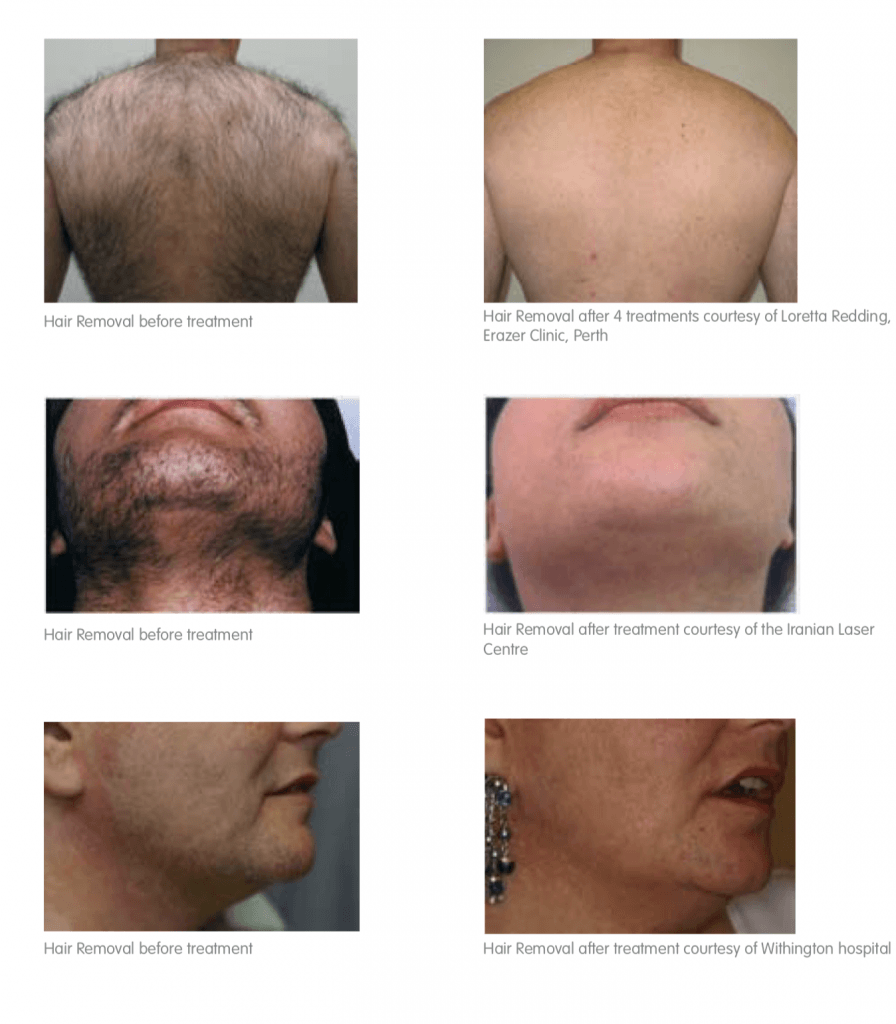
These before and after photographs were supplied by Lynton, the manufacturer of our IPL system, and were taken at other clinics.
What to expect during a consultation
Prior to any treatment, our laser technicians will provide a full consultation. The consultation identifies your expectations and provides a complete explanation of the treatment. Our Laser technicians take a full medical history to confirm your suitability for treatment. If you wish to go ahead with treatment, they will discuss everything on our consent form so you understand everything before signing it. They will then perform a patch test to confirm there are no adverse skin reactions to the light.
How do Intense Pulsed Light (IPL) and Lasers work?
Laser and Intense Pulsed Light systems release short bursts of light energy, which the melanin pigment in the hair absorbs. The highest concentration of melanin is in the bulb at the root of the hair, so that is where most of the heat is produced. The heat damages the follicle and reduces its ability to grow another hair.
How is Laser treatment carried out?
At Cheshire Lasers, we use Intense Pulsed Light for Hair Removal. You will be asked to put on goggles to protect your eyes. A layer of chilled gel is applied to the area to guide the light into the skin. The light guide is placed on the skin and a short pulse of light is released, targeting many follicles simultaneously. The applicator is then moved to the neighbouring area of skin and the process is repeated until the entire area is treated. The chilled gel is removed and the area is cooled.
Aftercare Sun avoidance is essential. We recommend daily use of a high factor, broad-spectrum sunblock.
Am I suitable for Laser Hair Removal?
The ideal patient is fair-skinned with dark hair, but results can also be achieved for fairer hair and darker skin types. The darker the hair, the more easily it is treated; as darker hair contains more melanin, it will heat up more easily. Fairer hair contains less melanin and is harder to treat.
Grey and white hair has no melanin, so IPL cannot treat it. Electrolysis works on hair of any colour — read about electrolysis at Cheshire Lasers for what is involved and current availability.
How does the Laser / IPL treatment feel?
No anaesthesia is required and most patients describe the discomfort as moderate and acceptable. Sensations vary, but most describe it as a very short hot pinprick that occurs very quickly when the Intense Pulsed Light is emitted, making it the preferred choice for Hair Removal.
As the hair reduces with subsequent treatments the discomfort often reduces.
What will I see after the treatment?
The hair follicles are damaged by heat but the hairs remain in the follicles. The hairs fall out after 1 – 3 weeks as the epidermis renews. During this period the hairs will seem to ‘grow’ as they are pushed out by the new epidermis.
Is Laser Hair Removal safe?
The skin can become quite red immediately after treatment, however, most patients experience no side effects and any skin reaction usually disappears within a few hours. Very rarely the skin may become lighter or darker, or small blisters may form.
How many treatments are necessary?
Only hair that is actively growing is affected therefore multiple treatments are needed. Treatment is conducted every 4 – 8 weeks, depending on the site treated, until a satisfactory result is seen. The number of treatments required varies, but most people need a course of 6 to 9 treatments for the best result. Maintenance treatments are usually needed from time to time afterwards to keep the area clear.
How long does each Laser /IPL hair removal treatment take?
Treatments can take from 15 minutes to an hour, depending on the area being treated.
See Lynton’s information sheet on laser hair removal, with more before and after pictures.
View our Pre and Post IPL and Laser Treatment information here.