Dr Teri Johnson MBChB is Medical Director of Cheshire Lasers in Middlewich, established 2008. She qualified in medicine at Liverpool University in 1993 and was a GP partner at The Oaklands Medical Centre for 25 years, retiring from general practice in 2025. She is GMC registered, a full member of the British College of Aesthetic Medicine, a BCAM appraiser since 2015, and Save Face accredited.
It is a massage treatment based on a system of traditional medicine which has been practised in India for over a thousand years.
The aim is to release the stress that has accumulated in the tissues, muscles and joints of the head, face, neck and shoulders.
What does Indian Head Massage Involve?
The client usually sits in a massage chair for the treatment. Our therapist uses a range of different movements, including application of deep kneading and compression movements over the neck, shoulder and scalp areas. In addition, our therapist will also gently stimulate key pressure points on the face. This treatment is especially good for relieving stress, tension, fatigue, insomnia, headaches, migraine and sinusitis. The technique also helps increase joint mobility and flexibility in the neck and shoulders, improves blood circulation and lymphatic flow, frees knots of muscular tension, relaxes connective tissue, and aids in the elimination of accumulated toxins and waste products. It is particularly good for reducing the effects of stress and tension.
Conditions that can benefit from Indian Head Massage are as follows:
Neck and shoulder pain
Face pain
Scalp conditions
Anxiety
Stress
Osteoarthritis
Rheumatoid arthritis
Asthma
Bronchitis
Depression
At Cheshire Lasers, Indian Head Massage is performed by the following specialists:
What is Eye Movement Desensitisation and Reprocessing (EMDR)?
EMDR is a treatment for distressing memories; those memories may be related to trauma such as sexual abuse, childhood neglect, road traffic accidents or violence. It can also, be helpful for phobias, traumatic grief, pain and performance anxiety. Traumatic memories can become blocked in the brain which then causes symptoms of anxiety and intrusive images.
You may have tried to avoid the thoughts and certain places related to the trauma because of this. The brain stem is triggering the fight/flight response. The Amygdala in the brain becomes overcharged by the blocked memory as it remains unprocessed and undigested. It then affects the thinking process.
EMDR treatment uses bilateral stimulation activating the left and right brain hemispheres. It activates the memory networks allowing the memory to be processed and digested. The bilateral stimulation can be auditory, tactile, sensory and also visual stimulus. It may trigger off other memories that you may not have been aware of.
Please consult the following web address for further information on EMDR;
During a treatment, Tara will perform an initial consultation to ensure the treatment is right for you. She will then ask you to lie on your side on a therapy bed. Tara will gently insert a candle in the first ear and then the other.
The treatment includes a relaxing facial massage to encourage lymph flow, and you have the option of having some complimentary Reiki to finish.
Cheshire Lasers values your privacy and want to be clear about the data we collect, how we use it and your rights to control that information. This policy reflects the high standards established by the General Data Protection Regulation (GDPR), a set of laws passed in the European Union. It applies to information collected by us or provided by you, during your appointment, via email, our website, or in any other way, including over the phone.
We are committed to protecting the privacy of our patients/clients. This privacy policy is intended to inform you on how we gather, define and use your data.
All your personal data will be held and used in accordance with GDPR and national laws implementing GDPR and any legislation that replaces it in whole or in part relating to the protection of personal data.
Information Collection
We do not collect personally identifiable information about you except when you provide it to us directly or through a third party. For example, if you subscribe to our MailChimp newsletter, complete a Jotform online survey, leave a review on reviews.co.uk, book a treatment with us, or consent to have a treatment with us or make a purchase.
The Information we Record via our Website
When you visit our websites (via a computer, mobile or hand-held device), you may provide us with personal information, including your name, address, contact details and financial data (via Pay Pal of Fresha).
This information is gathered when you register or book an appointment online using the Daysmart appointment System, email the Clinic, make a purchase from the online shop or, sign up for our newsletter (via Mail Chimp), complete a Jotform online survey or leave a review on reviews.co.uk.
Our websites use the Google Analytics cookie. The Google Analytics cookie allows us to see information on user website activity including, but not limited to page views, referral and average time spent on the website. The information is depersonalised and is displayed as numbers, meaning it will not be tracked back to individuals, which helps to protect your privacy. Using Google Analytics we can see what content is popular on our website, and strive to ensure you have the best user experience possible.
Our websites may contain links to or from other websites. Please be aware that we are not responsible for the privacy practices of other websites. This privacy policy applies only to the information we collect on this Site. We encourage you to read the privacy policies of other websites you link to from our site or otherwise visit.
The information we Record via Emails
When you correspond with the Cheshire Lasers by email, we may need to retain the content of your email and any photographs supplied together with our replies, as they form part of your medical records.
The Information We Record During Your Consultations & Treatment Appointments
When you visit the Cheshire Lasers Clinic you provide personal information including your name, address, date of birth, contact details and medical history.
During your consultation medical notes are taken, which may include any allergies, operations and medication. We also record treatment data which may include details of treatments or procedures you have had.
Depending on the treatment, photography and prescriptions may sometimes be required. This will form part of your treatment/medical records.
During your visit you may be asked to read and sign consent and after care forms which form part of your treatment/medical records. During your treatment we will record treatment settings, outcomes and may take photographs which form part of your treatment / medical records.
How We Use Your Information
Your personal details and medical records are for legitimate purposes and ensure we are able to :
Provide the best possible care
Provide Beauty, Medical and Aesthetic treatments safety
Identify any contraindications you may have for specific treatments
Diagnose medical concerns, provide treatment plans and write prescriptions
Maintain an accurate appointment diary for all our specialist
Confirm your appointment by text, email or phone
To answer your questions by email or phone
Keep you up to date on news and treatments offered by the Clinic
To contact you for post-treatment follow up and care, including survey requests in order to improve our service
You have a responsibility to inform us if any of your details such as name, address, contact numbers change, so our records are accurate and up to date for you. Generally, we do not rely on consent as a legal ground for processing your personal data, other than in relation to sending marketing communications to you via email.
Marketing
We use MailChimp as our marketing automation platform. By agreeing to this, you acknowledge that the information you provide will be transferred to MailChimp for processing in accordance with their Privacy Policy. You have the right to ask us not to process your personal data for marketing purposes and can opt-out from marketing at any time. This can be done by unsubscribing to one of their emails or we can unsubscribe for you. This will not affect our use of your data to contact you to remind you about your appointments.
Taking Payments
We take card payments using our Fresha Appointment System, Fresha Card machine, World Pay credit card machine in the clinic and Pay Pal for online product payments. These third parties have access to your Transaction Data and have their own GDPR-compliant policies.
Appointment System
We use Day Smart, formerly known as Appointment Plus, for our associate’s appointment diary; this enables you to book appointments online with most of our associate specialists, and it also sends automatic appointment confirmations and reminders. We store your contact details, such as Name, address, email and phone numbers here in order to identify you and send you confirmations and reminders in case we need to inform you of anything related to your appointment. Please view here for more information on Appointment Plus and its data policy.
Fresha System
For our aestheticians, we use the Fresha appointment system; this system is also used to take our payments. We store your contact details, such as Name, address, email and phone numbers here to identify you and send you confirmations and reminders if we need to inform you of anything related to your appointment. This system will also ask you to enter your card details to reserve your appointment and ask you to confirm you accept our 48-hour cancellation policy. Our staff can no see add or remove your card details.
You can remove your card details from the Fresha system at any time. Simply click on this link log in to the system to access your details and click on the three dots next to your card details and click remove card. To enter your card details you must have set up an account as Cheshire Lasers can not add the details for you.
You can also edit or remove other details on the system using the same link.
If you have forgotten your password, please enter the email you used to set up the account and click forgot password. Alternatively, you may have used Facebook or Google to set up the account.
Treatments requiring prescriptions
At Cheshire Lasers, some treatments require a prescription by a doctor or prescribing health practitioner. These prescriptions will need to be sent to a pharmacy to provide your agreed treatment. Opting out of sharing your information with these providers may affect our ability to treat you. All our suppliers have entered into appropriate confidentiality obligations and/or contractual data processing clauses with us.
How We Maintain Confidentiality of your Records
Every staff member has a legal obligation to keep information about you confidential.
We have put in place appropriate security measures to prevent your personal data from being accidentally lost, used or accessed in an unauthorised way, altered or disclosed. In addition, we limit access to your personal data to those employees, agents, contractors, and other third parties who have a business and need to know such data. They will only process your personal data on our instructions and they are subject to a duty of confidentiality.
We have put in place procedures to deal with any suspected personal data breach and will notify you and any applicable regulator of a breach where we are legally required to do so.
Depending on the service you use your records are locked away or stored electronically in a GDPR compliant software system. All digital data is secure and is highly protected from unauthorised persons and is also protected from deletion or malicious hacking.
How We Share Your Information
We will only share your information if you have given us written permission to make/cancel appointments with a family member/employee.
We do not sell our database to third parties.
We never share any information with third parties unless there is a genuine need for it, or we receive their request in writing and we have your written consent.
Disclosure of Personally Identifiable Information
Fraud Protection and Compliance with Law
We may need to disclose your personal information or share your personal information in order to comply with any legal or regulatory requirement, obligation or request. This includes the police for the prevention or investigation of a crime, HMRC, or our Insurers, legal advisors or other third parties who need access to it in the context of managing, investigating or defending claims or complaints.
Service Providers
We may retain other companies and individuals to perform functions consistent with our Privacy Policy on our behalf. Examples include customer support specialists, webhosting companies, credit card processing companies, fulfilment companies (e.g., companies that fill product orders or coordinate mailings), data analysis firms and email service providers. Such third parties may be provided with access to personally identifiable information needed to perform their functions, but may not use such information for any other purpose. We require all third parties to respect the security of your personal data and to treat it in accordance with the law.
How long do we hold your information?
We will only retain your personal data for as long as necessary to fulfil the purposes we collected it for, including for the purposes of satisfying any legal, accounting, or reporting requirements.
By law, we have to keep basic information about our customers (including Contact, Identity, Financial and Transaction Data) for six years after they cease being customers for tax purposes.
As a medical clinic, we are required to hold medical records for ten years from your last treatment.
Job applications and unsuccessful interview candidates – 6 months
Employee Records – Indefinitely
Marketing Enquiries and Emails – 6 months
Your Rights
You can withdraw your consent at any time by contacting us via email or letter. We will no longer contact you, although medical records must be retained for ten years. Where we are required to collect personal data by law, or under the terms of the contract between us and you do not provide us with that data when requested, we may not be able to perform the contract (for example, to deliver goods or services to you). If you don’t provide us with the requested data, we may have to cancel a product or service you have ordered but if we do, we will notify you at the time.
You have the right to request a copy of your medical records and this request must be put in writing and signed by the patient. We are required to respond to you within 30 days.
You have the right to have information updated or corrected if you feel it is inaccurate, incomplete or out of date. This request must put in writing and signed by the patient.
Changing our Privacy Policy
Our privacy policy will be reviewed regularly and updated as needed or as required by law.
The revised policy will be displayed on our website and a notification displayed in our waiting room. Where necessary, you may be asked to sign the consent form again.
Objections & Complaints
Our Data Protection Officer ensures the Clinic keeps your information secure and confidential.
If you have concerns about the way your information is managed please contact the clinic on 01606 841255 or email cheshirelasers@aol.com
If you are still unhappy, you can then complain to the Information Commissioners Office (ICO) at www.ico.gov.uk or telephone 0303 123 1113.
Data Breaches
Cheshire Lasers Clinic has a data breach policy, and in the unlikely event of a breach occurring, a further investigation will be held. Lessons learnt will be added to the policy, and the relevant supervising bodies will be notified if required.
Changes to our privacy policy
Any changes we may make to our privacy policy in the future will be posted on this page.
This privacy policy was last updated on 9 January 2024.
Scalp Micropigmentation is also known as “SMP”, “Medical Scalp Tattoo” or “Medical Hairline Tattoo”. It is a non-surgical, cosmetic solution for males and females who suffer from hair loss and thinning hair. It creates the illusion of real hair.
Using the most advanced precision machine and medical-grade ink, this treatment places small dots into the dermal layer of the skin on your scalp (just beneath the surface).
This procedure can be used to create new hairlines, fill in thinning areas of stubble, cover areas of Alopecia, camouflage scaring from hair transplants and add density to thinning, longer hair.
If your hair loss or thinning hair makes you feel self-conscious, then Scalp Micropigmentation will offer you instant, natural-looking and truly life-changing results.
Do you have Hair Transplant Scars?
Scalp Micropigmentation can camouflage your scars from FUT and FUE hair transplants. This non-surgical treatment makes them appear less visible to the eye. Medical-grade ink replicates your natural hair follicles and gives the illusion of real hair. It is an excellent solution for males and females, offering instant, natural looking and genuinely life-changing results.
Frequently Asked Questions
Deciding to have Scalp Micropigmentation / Medical Scalp Tattoo treatment can be very difficult, and you will undoubtedly have many unanswered questions. Below are some answers to the most frequently asked questions.
How does it work?
The pigment shade is matched to the colour of your natural stubble or hair. Over 3 – 4 sessions, layers of the medical tattoo pigment are built up in the scalp to create the coverage and density you desire. You will need to wait at least two weeks between each session.
How long will my Results last?
The pigment will last for 3 – 5 years. This will vary from person to person and depends on various personal and environmental factors. We recommend a top-up every 12 – 18 months to help keep the pigment intensity.
What Pigments do you use?
Helena uses medical-grade pigments which contain only natural ingredients. The pigment inserted into the scalp dont contain heavy metals like tattoo inks; therefore, it will never change its colour and will only fade gradually lighter over time.
What colours are your pigments?
There are ten shades of pigment, ranging from Light Grey to Black. For the best results, clients’ hair colour must be Light Grey to Black or Dark Brown.
Is Scalp Micropigmentation painful?
The majority of clients find the treatment bearable and feel minimal discomfort.
But if the procedure does become too uncomfortable, then an anaesthetic numbing cream can help reduce the discomfort. You can also take x2 Paracetamol or Ibuprofen 1 hour before your treatment.
Will my head be red after my treatment?
Your head will be red after each session, and this will settle down within 2 – 3 days. The degree of visible redness will depend on your skin’s sensitivity and colour. You should not be in any discomfort after the treatment has finished.
What makes a good result?
Scalp Micropigmentation creates a natural and realistic illusion of hair follicles. Your hairline will be soft, and feathered and complement the angles of your facial features. The layers of dots will work together to give a 3D illusion.
Will my Scalp Micropigmentation be noticeable?
The beauty of scalp micropigmentation is that it gives you instant and natural looking results. You will be amazed by how the majority of your close friends and family will not notice that you have had the treatment done. If you decide to tell them, they will be overwhelmed at how natural and realistic your results are.
Who cannot have Scalp Micropigmentation done?
Unfortunately, you cannot have this treatment done if you suffer from: Systemic Lupus Erythematosus, Keloid or Hypertrophic scars, TB, Tumours, Growths, Cysts, Alcohol or Drug Addiction, HIV Positive, are pregnant, nursing, or undergoing Chemotherapy or Radiotherapy.
What Guarantee do you offer?
Helena offers a six-month guarantee. If any fading occurs during the first 6 months after your treatment, she will top up that area for you free of charge.
Why choose Scalp Micropigmentation at Cheshire Lasers?
Here at Cheshire Lasers, we understand that losing your hair can be a very sensitive subject to discuss. It is important that you find the right clinic for your treatment, but most importantly, the right Technician and Artist you can trust.
Scalp Micropigmentation at Cheshire Lasers is carried out byHelena Fryer, an independent visiting specialist. Helena’s before-and-after results are extremely impressive. The treatment not only gives her clients the look of a full head of hair again but really helps to build their self-confidence. Consultations with Helena are free of charge.
Eyelash tinting involves carefully dying the lashes with safe, natural tints to give them a natural darker appearance. Many different eyelash and eyebrow tint colours (including blues, browns, blacks and greys) are available so we can complement your skin and hair colouring perfectly.
Professional eyelash tinting and eyebrow tinting will help to give depth to and enhance the colour of your eyes.
Who can benefit from eyelash and eyebrow tinting?
You do lots of sport (especially swimming)
You’re sensitive to make-up
You find the daily make-up ritual too time consuming
You’ve got very fine eyebrows – an eyebrow tint will help
You simply want to enhance your looks
You don’t like the ‘panda eyes’ that can result with mascara
You’re a contact-lens wearer who’s tired of the hassle of applying mascara!
What does a typical eyelash or eyebrow tinting session involve?
At least 48 hours prior to having your tint we’ll do a patch test; this is essential to ensure that you aren’t sensitive to the tint. Once we know there’s no reaction, we’ll agree the best eyelash tint for your hair and complexion. The tinting, which involves the careful application of safe natural dyes to your lashes, takes about 15 minutes – and can last up to six weeks.
A patch test is required at least 48 hours before tinting to ensure you do not have an allergic reaction
Who Performs Lash and Brow Tinting at Cheshire Lasers?
At Cheshire Lasers, Jade Mainesperforms eyelash and eyebrow tinting.
Electrolysis is carried out at Cheshire Lasers by Helena Fryer.
Electrolysis has the longest known track record for long term effective results for hair removal. Dr Charles Michel first used it successfully in 1875 to remove ingrown eyelashes.
What is Electrolysis?
Electrolysis is performed by inserting a very fine, flexible disposable needle into the hair follicle. Then a tiny amount of current is applied to destroy the lower part of the follicle. This stops any more hairs from growing from that particular follicle.
The destruction is carried out by heat (thermolysis), a chemical reaction (galvanic) or both blended together (blend). Virtually any area (apart from the inside of the nose and inner ear) can be treated.
Electrolysis is particularly good for clients who are not suitable for IPL laser treatment – for example those with grey / blonde hair and hairs in moles. It is also very effective for treating the stronger hairs associated with hormonal hair growth, especially on the face.
Why do people have unwanted hair?
Statistics show that most people have facial or body hair, which they feel detracts from their appearance. Superfluous hair growth is often the result of normal changes in which both males and females undergo throughout life. As humans advance through puberty, pregnancies, menopause, midlife and ageing, fluctuations in hormone levels in both genders may cause increased hair growth in areas that have never before been affected. Excessive hair may also be hereditary, due to medication side effects and even stress. It can be associated with endocrine dysfunction, which may cause irregular menstrual cycles, ovarian disorders, and diabetes or thyroid irregularities.
What areas can you treat with Electrolysis?
Electrolysis can be performed on any normal, healthy skin except for hair from the mucous membranes inside the nose, inside the ears, moles (unless you can provide a written release from your GP), and any known area with skin conditions. As the process can be quite time consuming, it is best suited to small areas such as the face or abdomen.
How long will my treatment session last?
The average treatment ranges from 15 minutes to 1 hour. Many electrolysis clients find weekly or biweekly sessions of 15 to 60 minutes to be most effective the amount of time per treatment depends upon the reaction of the skin to treatment, and the client’s sensitivity. Timing also depends on what part of the body is being treated. The first treatment could last about 15 to 30 minutes, increasing to 60 minutes as the client’s sensitivity lessens.
How much hair can you remove in 1 session?
This is very much dependent upon the sensitivity of the client.
What will I feel during the treatment?
Even the most sensitive person should be able to tolerate the treatments. The careful, skilful insertion of the sterile, disposable, micro-fine electrolysis probe into the hair follicle should not hurt. The mild tingling from electrolysis treatment energy is quick, and then it’s over. The hair slides out of the hair follicle with ease, so does not feel like it was plucked or tweezed.
How can I remove hair growth between treatments?
It’s best not to use any other methods between treatments, like tweezing, waxing, or depilatories. However, extremely heavy growth can be trimmed with small manicure scissors or shaved with an electric razor.
How do I book an Electrolysis session?
Helena is not taking on any new clients at the moment.
She is, however, continuing to see her existing clients for top-up treatments.
For more information and to book a follow-up appointment, contact Helena directly:
Cheshire Lasers provides IPL hair removal at our clinic in Middlewich, Cheshire. The light is absorbed by the pigment in the hair and heats the root, so that regrowth becomes slower, finer and patchier with each treatment.
Most people come to us for the underarms, bikini area, legs, face or neck, and we treat a good number of men for backs and chests.
We use the Lumina AQS, made by Lynton Lasers, a few miles down the road in Holmes Chapel. There are gentler systems on the market, but we use IPL because our Lynton machine gives better results. Your treatments are carried out by our NVQ Level 4 laser technician.
Which areas can we treat?
We treat most areas of the face and body.
Face and neck: upper lip, chin, sideburns, jaw, earlobes, between the eyebrows and the neck, either as single areas or as a full face.
Body: underarms, upper or lower arms, bikini area, upper or lower legs, navel, chest, and the back and shoulders.
The bikini area can be treated as a bikini line, an extended bikini line or a Brazilian, on its own or combined with the underarms.
Areas can be combined in one appointment, and how long the treatment takes depends on how much is being covered.
How much is IPL hair removal?
Every course starts with a consultation and patch test, which is £30 and must be at least seven days before your first treatment.
Facial treatments are priced by the size of the area rather than by name — one small area, two small areas, a medium area, a large area, or a combination. These start at £49. Body areas start at £65 for the underarms.
Do you offer a discount for a course of treatments?
We offer a discount when you book a course of three treatments — see our current special offers. We do not sell larger packages. Most people do not need that many treatments in one block, and any that are not used are wasted.
Maintenance treatments after nine sessions
Once you have completed more than nine treatments on an area with us, you are welcome to come back for half-price maintenance treatments at any time, as long as you have had a treatment or a patch test with us within the last six months. A patch test on its own is £25.
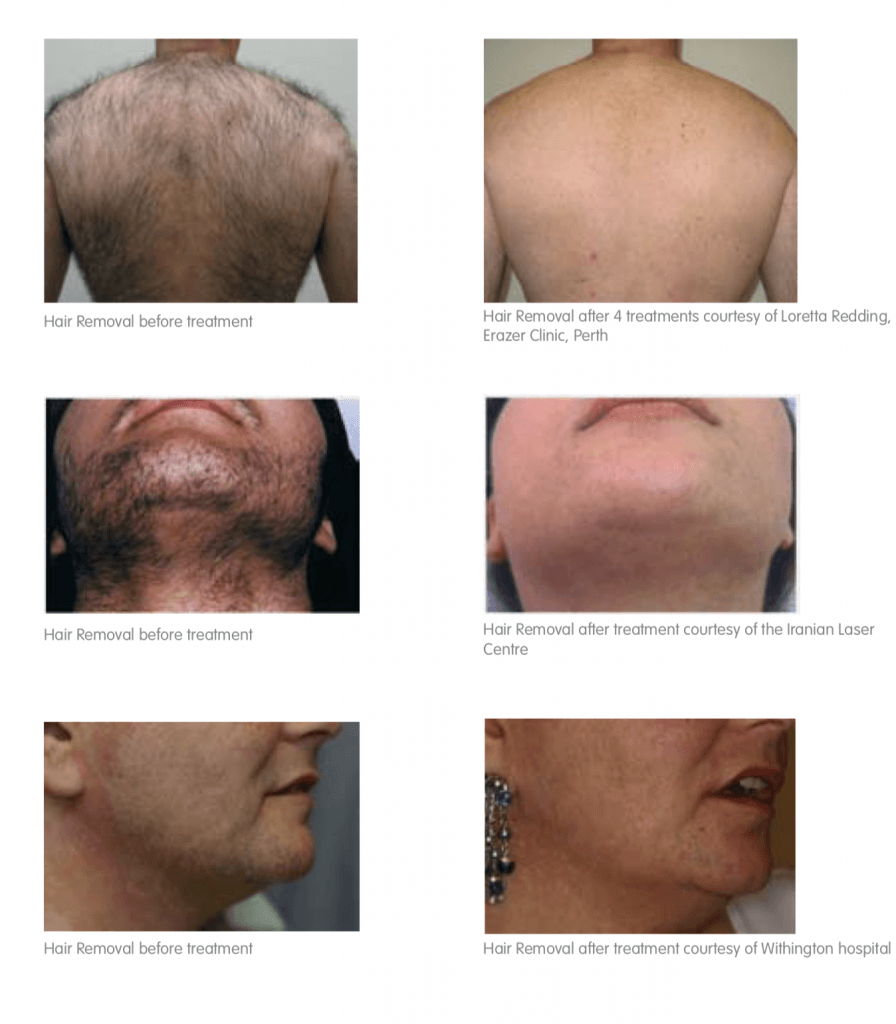
These before and after photographs were supplied by Lynton, the manufacturer of our IPL system, and were taken at other clinics.
What to expect during a consultation
Prior to any treatment, our laser technicians will provide a full consultation. The consultation identifies your expectations and provides a complete explanation of the treatment. Our Laser technicians take a full medical history to confirm your suitability for treatment. If you wish to go ahead with treatment, they will discuss everything on our consent form so you understand everything before signing it. They will then perform a patch test to confirm there are no adverse skin reactions to the light.
How do Intense Pulsed Light (IPL) and Lasers work?
Laser and Intense Pulsed Light systems release short bursts of light energy, which the melanin pigment in the hair absorbs. The highest concentration of melanin is in the bulb at the root of the hair, so that is where most of the heat is produced. The heat damages the follicle and reduces its ability to grow another hair.
How is Laser treatment carried out?
At Cheshire Lasers, we use Intense Pulsed Light for Hair Removal. You will be asked to put on goggles to protect your eyes. A layer of chilled gel is applied to the area to guide the light into the skin. The light guide is placed on the skin and a short pulse of light is released, targeting many follicles simultaneously. The applicator is then moved to the neighbouring area of skin and the process is repeated until the entire area is treated. The chilled gel is removed and the area is cooled.
Aftercare Sun avoidance is essential. We recommend daily use of a high factor, broad-spectrum sunblock.
Am I suitable for Laser Hair Removal?
The ideal patient is fair-skinned with dark hair, but results can also be achieved for fairer hair and darker skin types. The darker the hair, the more easily it is treated; as darker hair contains more melanin, it will heat up more easily. Fairer hair contains less melanin and is harder to treat.
Grey and white hair has no melanin, so IPL cannot treat it. Electrolysis works on hair of any colour — read about electrolysis at Cheshire Lasers for what is involved and current availability.
How does the Laser / IPL treatment feel?
No anaesthesia is required and most patients describe the discomfort as moderate and acceptable. Sensations vary, but most describe it as a very short hot pinprick that occurs very quickly when the Intense Pulsed Light is emitted, making it the preferred choice for Hair Removal.
As the hair reduces with subsequent treatments the discomfort often reduces.
What will I see after the treatment?
The hair follicles are damaged by heat but the hairs remain in the follicles. The hairs fall out after 1 – 3 weeks as the epidermis renews. During this period the hairs will seem to ‘grow’ as they are pushed out by the new epidermis.
Is Laser Hair Removal safe?
The skin can become quite red immediately after treatment, however, most patients experience no side effects and any skin reaction usually disappears within a few hours. Very rarely the skin may become lighter or darker, or small blisters may form.
How many treatments are necessary?
Only hair that is actively growing is affected therefore multiple treatments are needed. Treatment is conducted every 4 – 8 weeks, depending on the site treated, until a satisfactory result is seen. The number of treatments required varies, but most people need a course of 6 to 9 treatments for the best result. Maintenance treatments are usually needed from time to time afterwards to keep the area clear.
How long does each Laser /IPL hair removal treatment take?
Treatments can take from 15 minutes to an hour, depending on the area being treated.
Consultant plastic surgeon Rajiv Grover confirmed that the long-term use of Botulinum Toxin (Botox) delays the ageing process in the upper face.
The study came about after Grover carried out several consultations with patients seeking a second facelift (some years after having the first with a different surgeon) and began to notice differences between those who had used Botulinum Toxin over several years and those who had not.
Patients who had been receiving Botulinum Toxin injections consistently since their first facelift were far less likely to require a brow lift than those who had not, however, there were no significant differences in the bottom halves of their faces regardless of whether or not they had used Dermal Fillers in the cheek, jowls or neck.
This initial anecdotal evidence led Grover to carry out a formal study on 68 patients who had requested a secondary facelift following a previous one some years earlier. Out of these 68 patients, 24 had received Botulinum Toxin treatment regularly for over nine years.
Grover assessed the effects of ageing on the forehead and brow in three ways:
The height of the brow itself above the pupil of the eye was measured
Digital imaging software from Canfield USA to measure how much the brow had dropped with age by analysing pictures from youth and comparing these with current pictures
The need for a surgical brow lift, as a measure of the ageing process.
What did the study show?
The study reported that the patients who had received over nine years of regular Botulinum Toxin had significantly higher brows than those who had not, with an average difference of over 3mm.
The photograph analysis backed this up, finding that the inevitable drop in brow height caused by gravity and muscle movement during the ageing process was on average significantly smaller in the patients who had received Botulinum Toxin, indicating an alteration of the ageing process.
These results meant that Grover thought fewer of the Botulinum Toxin-treated patients needed a surgical browlift at the time of their facelift surgery than the Non-Botulinum Toxin group. In fact, only two of 24 Botulinum Toxin treated patients (8%) received a brow lift, compared with 24 out of the 44 remaining Non-Botulinum Toxin group (54%).
“This is the first study of its kind to look at the anatomical effects on the ageing process from long-term use of Botulinum Toxin,” said Grover. “By rebalancing the facial muscles it appears that Botulinum Toxin reduces the changes of drooping of the forehead and brow seen with ageing. The aim of this study is not to recommend that people take Botulinum Toxin in a long-term fashion but it is important that surgeons analyse in a scientific way what the long-term effects of treatment are in order improve safety for our patients.”
No part of the body will tell the story of your age more readily than your hands. The hands suffer environmental damage, and often have less protection than the rest of your body. Dryness, poor skin texture, age spots, uneven skin tone, visible veins, fine lines and wrinkles can all add to the general age appearance of your hands.
Want to know a person’s real age? Just look at their hands.
The natural fat cushion that we’re born with under the skin of the hands begins to lessen in our late twenties and early 30’s. By the time most of us hit 50, all the structures in the hand show up – the tendons, bones and veins.
Help is at Hand
Dr Teri Johnson and her team have been performing hand rejuvenation treatments since 2008. Over the years, they have tried and tested various treatments.
Hand Rejuvenation Treatments can address various concerns and include injectable and non-injectable treatments.
Non Injectable Hand Rejuvenation Treatments
Chemical Peels
Peels are great for fading age spots, smoothing the skin texture, and stimulating new collagen production in the upper skin layers. At Cheshire Lasers Clinic, our favourite treatment for hands is the BioRePeel with TCA. The BioRePeel has a bio-stimulating, revitalising & peeling-like effect. A single treatment often delivers a visible improvement, but for best results, we recommend a course of three every 7 to 10 days.
Microneedling
Microneedling uses tiny needles to create micro-injuries in the skin, stimulating collagen production and improving skin texture and tone. This treatment also is known for its ability to improve skin texture and can lead to a subtle improvement in pigmentation. At Cheshire Lasers, we use the EDS (Electronic Dermastamp) treatment.
Radiofrequency Microneedling
Radiofrequency microneedling combines the skin-renewing benefits of microneedling with the skin-tightening effects of radiofrequency energy. The result is a more effective treatment for improving collagen production, skin texture and firmness. Cheshire Lasers uses Dermaforce to deliver controlled heat energy deep into the skin through tiny needles. This stimulates more collagen production, often with less downtime than microneedling alone.
CACI Hand Rejuvenation
Using advanced microcurrent technology, CACI targets skin cells in the hands, stimulating collagen and elastin production. This non-invasive procedure tones, hydrates and firms the skin, reducing wrinkles and revealing smoother, younger-looking skin.
It’s also important to consider topical treatment when rejuvenating the hands. Retinoids, vitamin C serums, and moisturizers containing ingredients like glycolic acid or niacinamide can help improve the appearance of the hands over time by boosting collagen production and reducing signs of ageing. Regularly applying hand creams containing sunscreen can help prevent further sun damage and protect the hands from ageing.
Injectable Hand Rejuvenation Treatments
Injectable hand rejuvenation treatments involve injecting products into the skin to create volume in the skin, increase hydration or stimulate collagen production. Most treatments have an effect on all three of these.
The following treatments have all been shown to rejuvenate the hands:
Dermal Fillers: Dermal fillers, such as hyaluronic acid, plump up thin skin, give hydration, and minimise the appearance of wrinkles and veins.
Collagen Stimulators: Radiesse, Ellanse and Sculptra all stimulate collagen, creating firmer, tighter, plumper skin.
Skin Boosters:Restylane Vital, Profhilo, and Sunekos are examples of skin boosters they stimulate collagen and elastin production as well as hydrate the skin.
Polynucleotides: Made from DNA, stimulate fibroblasts to create collagen and elastin; they also stimulate hydration and have an antioxidant effect.
It’s important to consult with a qualified dermatologist or cosmetic surgeon to determine the most suitable treatment options based on individual needs, skin type, and desired outcomes.
Combination Treatments:
Often, a combination of treatments may be recommended to achieve the best results. For example, combining dermal fillers with laser therapy or chemical peels can address multiple concerns simultaneously and provide more comprehensive rejuvenation.
Examples of Hand Rejuvenation Treatments.
Restylane Vital Skin Boosters
Restylane Vital Skin Boosters contains small molecules of hyaluronic acid filler. When injected under the skin, it improves skin elasticity and deep dermal hydration. By moisturising from within it diminishes the fine crepey lines to give a plump and hydrated appearance.
An initial, intense treatment usually comprises three sessions, 3-4 weeks apart. Each treatment involves a series of very fine micro-injections however Dr Teri is now using a cannula more often for this treatment.
Typically, a maintenance treatment would be required after around 3-4 months.
Advantages:
Restylane Vital remains in the skin for about 4-8 months if not longer. It attracts water for skin hydration and improves skin texture while volumising the skin to help reduce the appearance of unsightly veins and tendons.
It can be dissolved by hyaluronidase.
Disadvantages:
3 treatments are usually required, and regular maintenance every 3-4 months to keep the effect.
Bruising is very common if injected with a needle.
Radiesse was launched in 2000 and is FDA approved. It is a non permanent Dermal Filler that contains calcium and phosphate based micro spheres. When injected under the skin micro spheres stimulate your skin to produce new collagen. It is, therefore, more commonly regarded as a collagen stimulator.
The product is injected directly into the skin with a cannula and then firmly massaged to ensure even coverage.
Radiesse gives an immediate improvement due to the presence of the filler. Over a few months, the results reduce slightly as the filler degrades. The results improve again as collagen production occurs creating a volume effect and an improvement in skin texture.
This treatment is great for volume loss to help cover veins and tendons in the hands.
You may only need one treatment. Although if you have older hands or hands with significant volume loss you may need a second treatment.
Advantages:
Typically, results last around 12 months.
You will need a maintenance treatment 9-15 months.
Disadvantages:
This product is not ideal for you if you have thin skin.
Radiesse filler is firm, so you need to apply strong, vigorous massage after treatment to reduce the risk of lumps after treatment.
The product does not give as much hydration.
Profhilo is a revolutionary injectable product based on hyaluronic acid (HA). After injection, it slowly breaks down so it remains in the skin for up to 28 days. While in place, it stimulates the body’s processes for regenerating skin tissue. It hydrates the skin and stimulates all four types of collagen and elastin. Hence, is why we call it a ‘bio-rejuvenator’ or ‘bio-revitaliser’.
Most people need two treatments one month apart. Older skin or extremely delicate thin skin prone to tearing may need a third.
You will need a maintenance treatment after 4-6 months for best results.
Advantages:
It degrades quickly, which often suits people who like minimally invasive natural treatments.
Treatments are easy and quick and take only 15 to 20 minutes.
The treatment is the best for thin, crepey, delicate skin.
Disadvantages:
The hydration effect creates some volumisation of the skin. However, this is often insufficient to cover visible veins and tendons due to fat loss under the skin.
Aliaxin SR is made by IBSA the same company that makes the revolutionary Profhilo. It contains 3 different hyaluronic acid molecules. One of which is the same as the one in Profhilo. The other two act more like a filler designed to hydrate, plump and volumise the skin.
Aliaxin SR is injected in the hands with a cannula. Gentle to moderate massage is then required to make sure the product is distributed evenly in the tissues.
You need one or two treatments for best results, one month apart.
If you have very thin skin a Profhilo treatment is recommended first.
You will need a maintenance treatment after around 6 months for best results.
Advantages:
This product is the best of all worlds, collagen stimulation in the skin itself to improve texture, elasticity. However it also gives volumisation, to plump and hydrated the skin due to the hyaluronic acid filler component.
Disadvantages:
You need to massage after treatment. Massage is not always possible in elderly frail skin unless this is improved first.