Dr Teri Johnson MBChB is Medical Director of Cheshire Lasers in Middlewich, established 2008. She qualified in medicine at Liverpool University in 1993 and was a GP partner at The Oaklands Medical Centre for 25 years, retiring from general practice in 2025. She is GMC registered, a full member of the British College of Aesthetic Medicine, a BCAM appraiser since 2015, and Save Face accredited.
Cheshire Lasers offers a range of holistic therapies. These services are available in the safe hands of our holistic associates, all of whom have years of experience.
Enhancing general health in preparation for conception. Reflexology may help couples with fertility problems by supporting general well-being, relaxation, and hormone balance. It can also help regulate periods, promote ovulation, reduce PMS, and increase sperm quality and quantity. Fertility problems can be very stressful, and a course of reflexology can help balance the body and mind for improved well-being.
Ideally, three months is the best time for couples to start preparing with regular treatments. Reflexology encourages the elimination of toxins, aids relaxation, reduces stress and anxiety, and aids improved sleep, all factors that may affect the body’s natural cycle and balance. A course of treatment is recommended.
During pregnancy, holistic therapies can help relieve pregnancy-related discomforts and support sleep and relaxation. Many women also find reflexology provides relaxation and emotional support as they approach childbirth.
Sharron has taken additional Reflexology training to help reduce the symptoms people experience during menopause, an issue many women suffer from. Reflexology can help reduce hormonal fluctuations that contribute to mood swings, fatigue and many other menopause symptoms.
Nail Surgery is performed by Samantha Hatton, podiatrist, at Cheshire Lasers in Middlewich.
What is Nail Surgery?
Nail surgery is a permanent solution to ingrowing toenails and other painful nail conditions. It may also be referred to as partial or total nail avulsion and is carried out under a local anaesthetic.
What Does Nail Surgery Involve?
At Cheshire Lasers, Nail Surgery is carried out by Samantha Hatton. She is a prescribing podiatrist, and she uses Local anaesthetic for the procedure.
During a partial nail avulsion, the troublesome section of the nail is removed and a chemical is applied to the nail bed to prevent it from regrowing. In some cases, it may be necessary to remove the whole nail plate.
The whole procedure takes about an hour. You will need to go home and rest with your feet up for the rest of the day.
How long will it take to recover after Nail Surgery?
The healing period can vary depending on the type of surgery carried out and is generally between 4 -10 weeks.
During this time, the toe/s will need to be bathed daily in salt water and redressed with a dry dressing. Most people do not require extra time off work or school; however, it is advisable to avoid sports or vigorous activity for a few weeks to allow effective healing.
How Successful is Nail Surgery?
This procedure is over 97% successful.
How Much is Nail Surgery?
The price varies depending on the complexity of the nail surgery and the number of toes operated on in one session.
The nail surgery price includes:
Nail surgery assessment
Nail Surgery procedure
Follow-up dressing appointments
Dressing materials required for daily dressing changes
For an accurate nail surgery price, we recommend a podiatry assessment with Samantha first, so she can advise you further.
Before and after CACI treatments, showing Jowl Lift.Before and after a CACI Eye Revive Treatment.Before and after a course of CACI Eye Revive Treatment.Before and after a course of CACI Eye Revive Treatment.
Marionette lines are creases that form from the corners of your mouth down towards either side of your chin. People often complain that they make them look sad, as the mouth turns down at the corners. They get their name as they resemble the appearance of marionette string puppets.
Why am I Getting Marionette Lines?
Marionette lines have multiple causes. They appear with advancing age due to volume loss in the face’s underlying structures. The commonest structures are bone and fat. As the face loses volume, gravity pulls the overlying skin down, and Marionette lines can start forming.
A contributing factor may also be the increasing strength of the muscles at the corners of the mouth, which pull the angle of the mouth down. Marionette lines develop more quickly due to lifestyle factors that reduce the skin’s collagen production, such as smoking and excess sun.
Are Marionette Lines Hereditary/Genetic?
You may have a genetic predisposition to developing marionette lines due to your underlying facial shape and the amount of volume loss you develop due to age. But as stated above, other factors also have an influence. Therefore, it is important to maintain the skin’s collagen levels by taking care of your skin, avoiding smoking and using sunscreen daily.
Will Marionette Lines Improve with Weight Loss?
Not usually; in fact, weight loss is usually a contributing factor in developing marionette lines. Weight loss can lead to volume loss in the face which then causes the soft tissues and skin to descend, causing the lines to look worse.
However, you may find that if you have gained a lot of weight recently, the distribution of fat around the face, particularly the jowl and neck area, may add to the gravitational pull of the lower face, making the Marionette lines more evident. In this case, weight loss may improve them.
Can Marionette Lines be Corrected/Treated/ Improved?
There are many ways to improve these lines, depending on the underlying cause and severity.
The area’s anatomy is complex, and treatment of this area will require a consultation first to assess the cause of your problem and give you a bespoke treatment plan.
The following treatments are the most successful, although for more severe lines, you may need a combination of several treatments for the best result:
Here at Cheshire Lasers, we only perform Dermal Fillers, Botox and Collagen induction therapies however, we will advise you if we feel other treatments are more appropriate.
How do Dermal Fillers Treat Marionette Lines?
Dermal Fillers can help improve this area in many ways.
Replace Volume Loss and Create a Lift
Dermal Fillers injected deep replace volume lost from the deep structures of the face, such as the cheek, chin and jawline. This creates support for the soft tissues of the face which can create a lifting effect that lifts the skin and improves the lines.
Supporting Sagging Skin
Dermal fillers can also improve the lines by injecting under them. Injections under the skin create a hydrating and plumping effect on the tissues under the lines, allowing the skin to support the sagging tissues below.
Can marionette lines be filled?
Yes, dermal fillers can add support to the facial structures, which, in turn, can help reduce Marionette lines. Fillers can also be added directly into the lines more superficially.
How can Botox Improve Marionette lines?
If you have overactive muscles pulling down the lower face. Botox is a treatment option; it reduces the downward pull at the corners of the mouth, which can help reduce the appearance of Marionette lines and create a subtle lift to the corner of the mouth.
How do Collagen Induction Therapies Improve the Lines?
Collagen induction therapies such as skin boosters, polynucleotides, microneedling, chemical peels and radiofrequency microneedling can help tighten the skin and improve skin quality. Full-face treatments deliver the best results as they can create a general lift that reduces the marionette area’s downturn and improves the skin’s support in the problem area.
Before and After Marionette Line Treatment with Dermal Filler
Content created by Dr Kyra Drinnan at Cheshire Lasers Clinic, Middlewich.
Tattoo removal takes a course of treatments rather than a single one, and some tattoos fade more readily than others. Black, blue and red respond best; green, yellow and purple are harder. Below you will find what is involved, how it feels, how the skin looks afterwards and how many sessions are usually needed.
Tattoo removal at Cheshire Lasers
Cheshire Lasers uses a Q-switched laser made by Lynton, a few miles down the road in Holmes Chapel. Q-switched lasers are the only type of laser that are safe and effective for the removal of tattoos.
This laser is very effective but expensive to buy, run and maintain, which is reflected in our prices.
What type of tattoos can our lasers fade?
Our laser can fade away tattoos of various size and colour. Tattoos are of two main types: the Indian ink amateur tattoo or the multi-coloured, professional tattoo.
What colour tattoos can it fade?
Single-colour tattoos usually respond best to laser tattoo removal. Multi-coloured, professional tattoos are much more difficult to eradicate completely.
Black, blue and red colours in the tattoo respond best to treatment, but green, yellow and purple pigment can be more difficult.
Green coloured tattoos require different lasers for successful treatment, and we may need to recommend a specialist clinic with a ruby laser to remove this colour.
At Cheshire Lasers tattoo removal is popular for people who:
Wish they had never got a tattoo
Who are looking to fade a tattoo for a new design
Need to remove a tattoo to help pursue a career
What happens during a tattoo removal treatment?
Active Q-switched lasers that generate a high powered beam of laser light in an extremely short pulse are the most suitable lasers for tattoo removal. The light is absorbed by the tattoo ink particles, breaking them down into smaller pieces, enabling your natural immune defences to absorb and disperse the ink. A gradual fading of the tattoo occurs over a series of treatments.
The skin is cleaned and the laser applicator is passed over the tattoo releasing quick pulses of light. You will hear an audible clicking noise as the ink particles shatter. After treatment, we will apply a dressing to keep the area clean and dry.
What does it feel like?
Most clients describe the sensation as similar to a hot pin prick or the flick of an elastic band. Whilst mildly uncomfortable, most people tolerate the treatment well. A skin cooling device may be utilised to reduce any discomfort.
How does the skin look after a tattoo removal treatment?
An instant whitening of the skin occurs but this generally fades quickly. The area is likely to feel tender for a few hours and can be red and swollen for up to 48 hours. Initially, the tattoo is unlikely to look any different but will fade over 4 to 8 weeks as the body breaks down and disperses the pigmentation.
What is the recovery period?
Some tattoos can graze or blister. If this happens, leave the area to heal naturally. After your treatment, we will apply a dressing. Keep the area dressed and covered until the area heals. This matters most if you develop blistering or grazing. It is also important not to pick the area while it is healing.
Very rarely the skin may become lighter or darker, or larger blisters may form.
Changes to skin texture and scarring are possible, though very uncommon, and are more likely if grazes are not allowed to heal naturally. There may be loss of natural tanning ability in the area treated which usually improves with time.
How many treatments will I need?
This depends on a number of factors such as the density and colour of the tattoo and the age of the tattoo. Amateur tattoos can be quick to remove, taking 1 to 6 treatments, whereas professional tattoos vary considerably and can take up to 14 treatments. We recommend you have your treatments every 6 to 12 weeks. The laser breaks the ink into fragments and your own body clears them away over the following weeks, so the tattoo carries on fading between appointments. The longer you leave between treatments, the more fading happens on its own and the fewer sessions you may need overall. There is no advantage in rushing, unless you want the tattoo gone as soon as possible — in which case six weeks is the shortest gap we would recommend.
Treatment can take 10 minutes to 30 minutes depending on the size of the tattoo.
Can a tattoo be faded rather than removed?
Yes. If you are planning a cover-up, a new design usually sits better over a lighter tattoo, so the aim is to fade the old one rather than clear it completely. Most of our clients who ask for fading need between two and four treatments to achieve what they want. We can also work on part of a tattoo only, removing a name or a section while leaving the rest alone.
It is worth asking your tattoo artist how light they need the area to be before you start, so we can plan the right number of sessions between us. Fading uses the same laser as removal and feels the same, with the same aftercare, and it begins with the same consultation and patch test. Prices are by the size of the area treated, as below.
How much is tattoo removal?
Treatment
Price
Consultation and patch test
£30
XX-Small tattoo (up to 1 sq in)
£45
X-Small tattoo (up to 3 sq in)
£66
Small tattoo (up to 6 sq in)
£100
Medium tattoo (up to 10 sq in)
£135
Large tattoo (up to 15 sq in)
£185
X-Large tattoo (over 15 sq in)
£240
We measure your tattoo at your consultation using a grid of 1-inch squares (1 square inch is about 2.5 cm × 2.5 cm). We add up the area covered by ink, so two half-filled squares count as one square inch. That total gives your size band.
Prices are per session. Amateur tattoos can take as few as 1 to 6 sessions, while professional tattoos need considerably more. The patch test must be carried out at least seven days before your first treatment.
What are seborrhoeic keratoses (seborrhoeic warts)?
Seborrhoeic keratosis, also spelled seborrheic keratosis, is a harmless overgrowth of epidermal keratinocytes that you can find anywhere on the skin, and the cause is unknown.
They have several different names, including seborrhoeic warts and basal cell papillomas.
Seborrhoeic keratoses have a rough surface and appear to be stuck on the skin. They can vary in colour from your normal skin colour to almost black, most often occur on the stomach, chest and back and usually start to appear after the age of 40.
They are not true warts and are not contagious. However, they run in families, possibly due to genetics or skin type. They usually do not cause trouble, but occasionally, they can become inflamed, especially if knocked or caught in something like a zip.
Do seborrhoeic keratoses need treatment?
Seborrhoeic warts are usually harmless and, therefore, do not usually require treatment. However, some people arrange for their removal for cosmetic reasons. This is best done by scraping the wart away or by freezing it with liquid nitrogen.
For more complex lesions, Dr Will Allen may use a range of other surgical methods. He can discuss this at your consultation, which is better face-to-face, so he can thoroughly assess the lesion. However, you may prefer to email cheshirelasers@hotmail.co.uk an image of the lesion so we can get his opinion if you prefer some more information before you book.
Prices for seborrhoeic keratosis removal
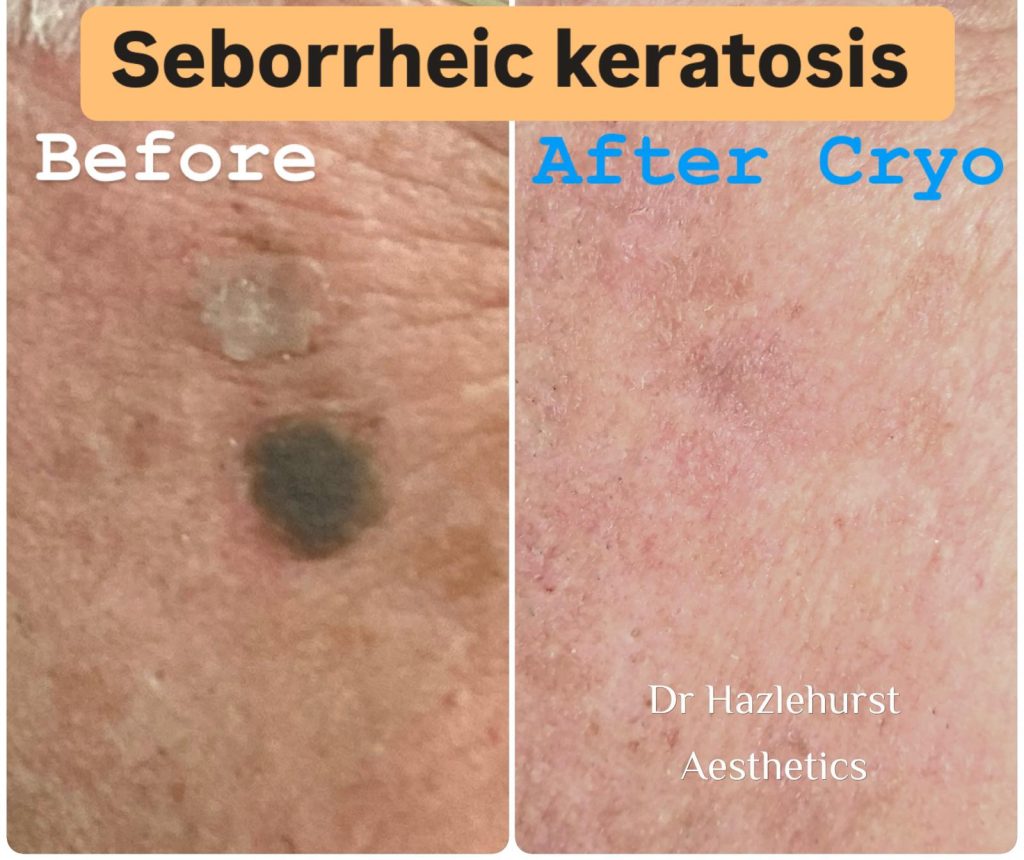
Seborrhoeic keratosis removal at Cheshire Lasers starts from £150 with Dr Kathryn Hazlehurst, using cryotherapy. Her consultation is £50, which is taken off the price of your first treatment, and she can carry out skin lesion removal during the consultation.
Larger or more complex lesions are removed by Facial Surgeon Dr Will Allen, who may use other methods such as shave excision. His consultation is £100 and is not deducted from the treatment price. Removal starts from £330.
Before and after photos of seborrhoeic wart treatment:
Send us a photograph first
If you are not sure which treatment you need, email photographs of the area from a couple of different angles to cheshirelasers@hotmail.co.uk. It’s helpful if you let us know how long the lesion has been there and whether it’s changing in any way. We will ask our specialists to review your email and advise our reception team on who you should see. Sometimes we will ask you to book a consultation first.
As we age, our pores get larger. This is because we lose collagen, which supports the skin and the structures within it. The more support is lost, the more pores dilate and appear bigger.
Your skin type also determines pore size. Large pores are more common with oily or thick skin. Pores become larger and more noticeable if they become congested with sebum, the oil we produce to protect the skin. A combination of old dead skin cells and sebum can block the pores and then oxidise into a black plug known as a blackhead.
Can large pores be removed for good?
Unfortunately, no treatment can remove large pores for good.
You can only improve/reduce them, and you will need to continue with treatments to maintain the results.
Do you use laser to treat large pores?
At Cheshire Lasers, we do not currently offer resurfacing laser treatment. If that is specifically what you are looking for, there are specialist clinics in Cheshire that provide it.
We prefer to use our Neogen and radiofrequency microneedling devices, which cause less downtime and fit better with our clients’ lifestyles.
How can I improve my large pores at home?
Good home skin care can make a big difference. Our favourite products are ZO Skin Health and pHformula, but we also use Medik8, Obagi, and many more, which you can view on our online shop.
Products for pores and younger skin
In younger skin, enlarged pores are more commonly associated with excess sebum, congestion and the accumulation of dead skin cells. In these cases, ingredients that regulate oil production, exfoliate and help keep pores clear can be particularly effective. Products such as ZO Instant Pore Refiner, Oil Control Pads, clarifying mask and Exfoliating cleanser can be considered based on individual skin type and concerns. You can view the products we recommend for enlarged pores.
Products for enlarged pores and ageing skin
In mature skin, simply exfoliating or controlling oil isn’t the answer. Instead, skincare needs to support collagen, elastin, and skin renewal. Improving overall firmness can help the quality and structure of the skin surrounding the pores, making them appear less prominent. Both ZO Skin Health and pHformula offer advanced anti-ageing ingredients such as retinol and growth factors that can support these processes, making them particularly relevant for mature skin.
You can view products we recommend to support ageing skin, which can then support your pores, in the following categories on the shop
Microdermabrasion is a facial treatment that blasts your skin with tiny crystals sanding off and removing dead skin cells. This treatment removes just the top surface of the skin and unclogs pores and blackheads. It also helps reduce fine lines and stimulates collagen which gives the pores more support.
Microneedling is another way to reduce pore size. This treatment uses a needling device to create thousands of tiny holes in your skin. The healing process stimulates the release of growth factors and stimulates the production of collagen and elastin, giving firmer skin, which supports the pores so they appear smaller. This treatment also helps resurface and smooth the skin’s surface, which also helps reduce pores.
A skin peel can smooth the surface of the skin making pores appear less noticeable. Cheshire Lasers offers a wide variety of skin peels. Choose from a milder peel which gives little or no downtime but are less effective and the results are short-lasting. Or a more aggressive peel which gives more peeling and more downtime and the results can last a few months. Many people opt for a course of mild peels and step up in strength until they achieve good results and then have a maintenance treatment every month or two.
The Hydro2 Facial begins with a deep cleanse that jet washes the skin to lift away dead skin cells, then uses a solution containing glycolic and salicylic acid to soften the blockages in the pores before drawing them out with gentle suction. Six further technologies can be added to the same treatment, so it can be tailored to oily and congested skin.
Radiofrequency (also known as RF), involves heating up the skin layers to stimulate collagen production. A course of 6 to 8 treatments can tighten and brighten the skin providing support for the pores, which can reduce their appearance.
Radiofrequency microneedling combines the two treatments above. We use Dermaforce, which passes fine insulated needles into the skin and releases radiofrequency energy from their tips, so the surface is resurfaced and the deeper layers are heated at the same time. It stimulates collagen at a depth ordinary microneedling does not reach, firming the skin that supports the pores so they appear smaller.
Neogen uses nitrogen gas converted into plasma energy. It resurfaces the skin evenly and reaches the deeper layers as well as the surface, improving skin texture as it heals and building collagen over the following months. That combination smooths the surface of the skin and firms the support around the pores.
Botulinum toxin is best known for softening expression lines and for reducing sweating. It can also be placed in tiny doses into the surface of the skin, rather than into the muscle beneath, where it causes a temporary reduction in oil production. In some people this makes the pores look smaller and the skin smoother. At Cheshire Lasers this is our Microtoxin Glass Skin treatment.
Which of these treatments should I choose?
The treatments that work under the surface of the skin tend to be the most effective, because they stimulate collagen to support the pores, which causes them to shrink from within. Three of the treatments above do this: microneedling, radiofrequency microneedling and Neogen Plasma.
Of the three, plain microneedling does the least. It creates the tiny channels in the skin, but there is no energy behind it, so it does not achieve as much as the other two.
Neogen and radiofrequency microneedling are about equal. They are different kinds of energy rather than one being better than the other, and the practical difference is in what happens afterwards: radiofrequency microneedling breaks the skin with needles, while Neogen heats the skin and leaves the surface intact until it peels. The aftercare and the reaction differ, so the choice usually comes down to which recovery suits you.
The other treatments here — microdermabrasion, skin peels and the Hydro2 Facial — work on the surface rather than the deeper layers. They keep the pores clear and make them look smaller, and many people use them alongside one of the three above.
Reflexology is based upon the principle that there are energy zones that run throughout the body and there are reflex areas in the feet and hands that correspond to all the major parts of the body. It is a complementary therapy that involves applying pressure to specific points on the feet or hands, which correspond to different organs and systems in the body.
This practice aims to promote health and well-being by stimulating these reflex points.
Benefits of Reflexology:
Increased circulation: by stimulating blood flow, reflexology may enhance the delivery of oxygen and nutrients throughout the body, potentially improving overall health.
Improved relaxation: may help alleviate stress and induce deep relaxation, contributing to overall well-being.
Sense of well-being
Supports the immune system
Elimination of toxins from the body
Lowers Blood Pressure.
Cancer Relief.
Detoxification.
Improve tension, stress and circulation associated with enhancing your own fertility.
Beneficial in supporting the symptoms in Pregnancy.
Enhanced Sleep Quality: The relaxation effects of reflexology might contribute to better sleep patterns, aiding those experiencing insomnia or disrupted sleep.
Digestive Support: Some individuals report relief from digestive issues, such as constipation, through reflexology sessions.
Hormonal Balance: Reflexology might aid in balancing hormones, which can be beneficial for individuals experiencing issues related to hormonal imbalances.
Immune System Boost: By promoting overall relaxation and balance, reflexology may support the immune system’s function, potentially reducing the frequency of illnesses.
Anxiety and Depression Alleviation: Reflexology may help reduce symptoms of anxiety and depression, promoting emotional balance and mental health.
Reflexology can help alleviate many problems, such as colds, sinusitis, migraines, asthma, sciatica and insomnia. It relaxes, reduces stress and detoxifies the body and can be used effectively as a preventative form of health care. It can bring a balance to conditions such as hormonal imbalances, digestive problems, back pain and headaches.
Problems Reflexology can help with:
Migraine
Stress, anxiety, depression
Back pain
Arthritis
Hormonal imbalances/PMS
Menopause Symptoms
IBS/digestive disorders
Stress-related conditions
Sleep problems
Fertility
Who Provides Reflexology at Cheshire Lasers?
At Cheshire Lasers Clinic, we have two highly experienced Reflexologists:
A Reflexology treatment (with or without specially selected aromatherapy oils) lasts for approximately 60 minutes. The first treatment, however, can take up to 90 minutes as a full client consultation occurs before the treatment can commence.
During a typical reflexology session, the reflexologist will take a detailed medical history. Sessions are usually performed in a comfortable chair or couch. The client will be asked to remove footwear and socks. The practitioner will make a visual and tactile examination of the area to be worked on before beginning the precise reflexology movements. The particular types of movements involved require the application of appropriate pressure using the thumb and fingers.
Why may I benefit from Reflexology?
Reflexology may be beneficial in restoring balance and harmony in the body and releasing tension. Practitioners believe that it helps facilitate a deep state of relaxation, calm emotions, and produce a serene mind. Research studies support many of these benefits.
Many people describe a profound sense of relaxation and increased energy following their session. In addition, specific studies indicate that reflexology may reduce pain and anxiety.
Reflexology is growing increasingly popular across Europe and Asia as both a complement to other treatments and as a preventive measure. One example is Denmark, where various municipalities and companies have employed reflexologists since the early ’90s.
According to several studies, this practice in Denmark has resulted in reduced sick leave and absenteeism (and significant economic savings for the employers). Employees have consistently reported a complete or partial improvement in conditions where they sought reflexologists’ help and even relief for additional problems related to stress. In one municipal district, almost one-third of the employees reported greater satisfaction with their jobs after completing six sessions with a reflexologist.
View the reflex areas in the feet and their corresponding parts of the body
At Cheshire Lasers, we provide many treatments for skin rejuvenation. You can achieve brighter, younger skin using chemical or physical agents to increase the skin’s cell turnover, stimulate collagen production, reduce lines and wrinkles and even skin tone.
The treatments below are the ones we use most. For the best results you may need a combination of them, and a consultation will narrow it down to what suits your skin.
Also known as Microtox, Micro-Botox or Mesobotox. Microdroplets of highly diluted botulinum toxin are placed into the skin’s surface layers to improve skin quality rather than alter facial movement, giving the “glass skin” look.
An injectable containing 6 amino acids and hyaluronic acid. It stimulates fibroblasts to produce collagen and elastin, improving dryness, tone and elasticity, dark circles under the eyes, acne scarring, sun damage and fine lines.
This high-tech treatment uses nitrogen plasma energy to rejuvenate the skin at all levels. It improves texture, pigmentation, collagen and elasticity, and softens wrinkles. It’s our only treatment for the eyelids.
Our strongest pHformula peel. TCA is normally an aggressive acid, but pHformula’s PH-DVC delivery complex carries it into the deeper layers to work there rather than damaging the surface.
RF Microneedling uses advanced technology to improve skin texture and tone and promote collagen growth, delivering smooth, plump, firmer-looking skin. Great for anti-ageing, reducing pore size, fine lines and superficial scarring.
For fine lines, wrinkles, pigmentation and sun damage. Brightens the skin and improves its elasticity, texture and tone. Available as a facial or a resurfacing treatment.
Using Injectable Collagen Stimulators like Sculptra, Ellansé, and HArmonyCa. Your skin can appear firmer, tighter and hydrated, and they can also add volume for a lifting effect.
Using injectable skin-boosting ingredients such as Profhilo, Polynucleotides like Nucleofill, PRP and Sunekos to stimulate collagen and elastin. Your skin can appear more youthful, hydrated, plump and fresh after a course of treatments.
An innovative medical peel that contains TCA for a more advanced result, but with minimal downtime and flaking. A quick treatment with instant results, suitable for all skin types.
An injectable treatment using the building blocks of DNA to repair and regenerate damaged skin, used in wound healing since the 1950s. It improves texture, tone and elasticity on the face, neck and décolletage.
Dermaplaning is a gentle skin rejuvenation treatment that uses a scalpel to manually exfoliate the skin and remove fine facial hair, leaving the complexion smoother, brighter and refreshed.
Often described as an injectable moisturiser. It stimulates collagen and elastin in the top layers of the skin, leaving it plumper and more hydrated after a course, and can even bring some lifting and firming.
Our most popular eye rejuvenation treatment involves three steps. It is not only relaxing and enjoyable, but it also soothes tired, puffy eyes, combats dark circles, reduces fine lines and helps lift hooded eyelids.
Ultrasound energy safely treats sensitive areas around the eye, mouth and forehead, stimulating collagen to reduce fine lines and wrinkles. Results build over a course of treatment, but one session can make a difference.
Platelet-rich plasma uses the platelets from your own blood. They release growth factors that stimulate your skin’s healing and repair. Used on the face, hands, décolletage and scarring, and for hair loss.
Not all pigmentation is the same. This page explains the three types we treat — sun damage and age spots, melasma and hormonal pigment, and post-inflammatory pigmentation — and which treatments suit each.
The Hydro2 Facial combines up to 7 technologies to improve your skin texture and hydration. The standard treatment cleanses, exfoliates, extracts, hydrates, and provides antioxidant protection. You can also add on radiofrequency and oxygenation treatments.
Our medical-grade microdermabrasion treatment removes the stratum corneum to reduce the superficial signs of ageing and scarring. Repeated treatments at regular intervals may stimulate collagen.
CACI micro-current tones and lifts the facial muscles. Enhanced Tissue Repair (ETR) pads and infused CACI products also work on the skin itself, improving texture and firmness. Results build over a course of treatments.
Radiofrequency energy stimulates collagen to improve skin elasticity and reduce fine lines and wrinkles, leaving skin smoother and brighter. ThermaClinic is excellent for the eyes, upper lip and full face.
A skin resurfacing system that sits between a cosmeceutical and a medical prescription treatment. We recommend pHformula home care to use between clinic treatments, or on its own.
A prescription-only skincare system that accelerates skin cell turnover, working deep to improve pigmentation and damage in all layers of the skin. Dr Hazlehurst prescribes it and supports you through the regime.
Radiofrequency that works deeper than our other devices, making it our best choice for the cheeks and neck. A dedicated handpiece treats the delicate skin around the eyes.
A physician-dispensed skincare range created by dermatologist Dr Zein Obagi, built around creating and maintaining healthy skin rather than only treating disease. It rejuvenates the skin from the outside in.
Using our Lynton Intense Pulsed Light system, we can reduce the signs of ageing caused by sun damage, and reduce or remove blemishes such as brown spots (pigmentation), redness (thread veins), or both.
Red, infrared and blue LED light, used up to three at once. Red and infrared are great for anti-ageing and skin rejuvenation; blue reduces oily skin and the bacteria in acne.
Not sure which treatment you need?
Skin rejuvenation covers everything from home skincare to medical peels and injectable treatments, so the right choice depends on your skin, how much downtime you can take and what you want to change. Book a consultation and one of our doctors or aestheticians will talk it through with you.